My Blog List

Sunday, November 26, 2017

WATER AND FIRE


2017 began with rains of record. Aquifers rose. For the first time in many years Kelsey Creek retained water downstream of town throughout the summer. The lake overflowed. Insects flourished. On the ranch, birds had great breeding success, with tree swallows and bluebirds fledging multiple broods. Wood ducks, Barn owls and black headed grosbeaks hatched.
After a cool Spring, the heat of Summer was relentless. By Fall, big wildfires swept the region.

In the delta of Kelsey Creek.

The first homesteaders in the Big Valley selected oak-shaded sites near water on which to build their homes.


This mid-summer clutch of tree swallow eggs never hatched. Instead, it cooked in the extreme heat. But several clutches laid earlier in the season successfully fledged.

Tree swallow nestlings, which later perished in the heat.

          Italian cypresses in the rain-shadow country East of the Coast Ranges in Colusa County.

Ranch in the rain-shadow.

The Three Graces at Stoneyford Store. 

Herds of elk move seasonally down to pasture around Stoneyford from Lake County's Mendocino National Forest. Some elk unwillingly give up their heads, which end up as wall-mounted trophies.
Taxidermy at Stoneyford store typifies the ubiquity of the craft throughout the West in country stores, bars, restaurants, lodges, sporting goods stores and private homes. Taxidermy is surely the region's most visible art form, a cultural touchstone speaking of the romance of wild country and big animals. The mounted specimens may be seen as reliquaries of animal magic, but unlike the carved animal effigies seen in African and Asian masks, here we have the animal itself... almost.
The visual effect on seeing rank after rank of every possible species of North American big game animal decorating the walls of a large sporting goods store, puts one in mind of a charnel house. 
  

 The coast ranges support many thousands of wild pigs, a hybrid of escaped stock introduced by early Spanish settlers in the 1700s and European wild boar introduced by hunters in the 1920s. Throughout the state their population is judged to be between 200,000 and 1 million, a rough guess indicating just how wily and illusive the animal is. Hunters can't make a dent in the numbers.

Old truck and trailer ornament  Finca Castelero.

Looking East from the Mayacamas Range over Clear Lake.


   Local craftsman's booth at the Kelseyville Pear Festival.

                                              Audubon Society booth at the Pear Festival.

In the show ring at the Pear Festival.

Kelseyville still resembles its former self.

                                                Historic pictures of Kelseyville Main Street.

                                                                      Pomegranate

                                                            Last tomatoes of the season.

                                                        Along my bike trip to the lake.

                                                           Groundwater Valley Oaks.


                                                Where Kelsey Creek meets Clear Lake.


                                                Freshwater clam shells along the lakeshore.

Catfish skull.

                                                              In the delta of the creek.

                                                       Soda Bay and Mount Konocti.

                                        I stopped my bike along the road from the state park.

                                                           Looking West in Big Valley.

East to Konocti.

A bald eagle seized a fish from an osprey at Letts Lake, Mendocino National Forest.


Monday, August 7, 2017

MIGRANTS & COSMOPOLITES

August nights in the oaks ripped with rasping calls of barn owl fledglings.
Inhabiting six continents, barn owls are among the most cosmopolitan of creatures. 
I installed sheet metal flashing on the post supporting the owl box, deterring raccoons and allowing the owls to breed successfully this year.  


Black headed grosbeaks, returning from such places as Michoacan and Jalisco, also bred well this season.
Four or five young of the year frequented the feeder trays.


From the garden beds.

Eurasian collared doves were accidentally released in the Bahamas in 1974, and have since conquered most of North America, the most successful avian invasive species since the European starling (1890) and the English sparrow (1850). They first showed up at the ranch three or four years ago.

Tiger swallowtail, unlike the long distance migratory monarch, probably hatched in the willows and cottonwoods along the creek across the road.

Thursday, June 15, 2017

MADE MANIFEST IN SPRING


Cliff swallows in dozens gathered mud with which to mold their globular nests.


      Flicker and red shouldered hawk shed feathers.
Violets and trillium.


Pomegranate blossoming profusely after a wet winter.


Sharptail snake hoping to be invisible by hiding her eyes under a bent straw.

St John's wort.


Garden beds.


Thunder, lightening, and hail brewing on June 11.


Hail.


The storm cleared after thirty minutes.


Night Studio.

THE HUMAN FOOTPRINT


I saw a sign, which revived a name associated with this place since the Benson family trekked across the continent to homestead in this valley. If the Bensons have moved on, the place and the name survives. Locally, the Benson name conjures tales of identical twins reduced to a diet of shoe leather in Death Valley, of Pomo artistry at the 1904 St. Louis World's Fair, of witness to a historical massacre, cultural mediation, racial blending, narrow escapes from grizzly bears, and the farming of pears.
  

Bill, the lawn mower repair master has died, leaving behind his self-made memorial pile of mowers, which appear to rival the floral tributes left for Princess Diana. As an artist ages and contemplates death, he might wonder if his own life's work will end up similarly.


 Charles Demuth's, My Egypt, his painting of totemic mid-western grain elevators, came to mind as I walked by the pear and walnut packing sheds.


A couple of vultures attended the victim of vehicular fox slaughter. They risked their own lives for a meal in the road. I moved the fox well away on the shoulder.


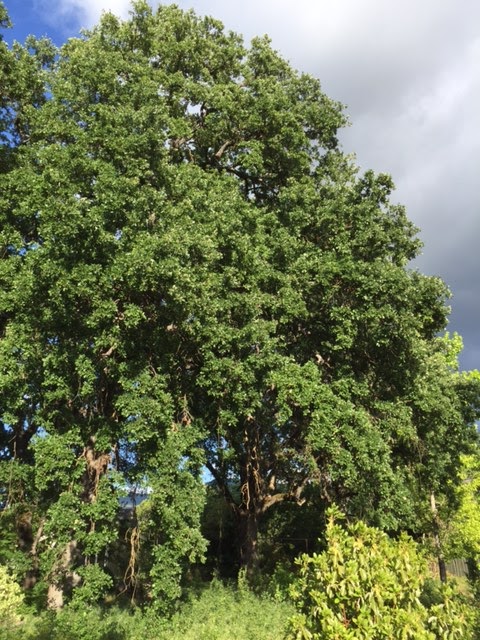
The oak has seen the little town of Kelseyville grow up around it in the past 150 years.


THE OAK SAVANNA

The sense of space in the Valley Oak Savanna changes radically through the months of April and May as the great trees first flower and then leaf out, forming dense canopies.

To walk in their shelter is to feel an aura of remembrance. 
When ancient lake bed clay and silt was exposed as waters receded, acorns took root. The pioneering generations of oaks in Big Valley provided fodder for ground sloths, camelids, early horses, and prototypical grizzlies. Humans reached the valley ten thousand years ago, killing off most of the megafauna. But grizzlies, deer and elk continued to frequent the woodlands. Directly, the oak's acorns became the central source of sustenance for the humans.

Trees alive today can be 600-years-old and 70' tall. A tree that age spent three quarters of its life in the company of the Pomo peoples and grizzlies. It sheltered General Vallejo's wandering cattle herds during the Mexican period. The creek-side Valley Oaks were fertilized by shoals of rotting hitch, which after spawning, were often stranded as creek water levels subsided. 

These long-surviving trees stood as the first Anglo-Americans arrived and subjugated and enslaved the local Pomo. Some trees today might well have served as hanging trees.

The new Americans built their first homesteads in the micro-climates beneath the oaks.
Relentlessly, they cleared over ninety percent of the valley's oak savannas, replacing them with fields of wheat, and orchards of pears and walnuts.

On a four mile walk around our agricultural block, I see remnants of the ancient savannah, richly inhabited oases of life punctuating the farm monoculture.