Thursday, September 3, 2009

Month of Flocking Crows


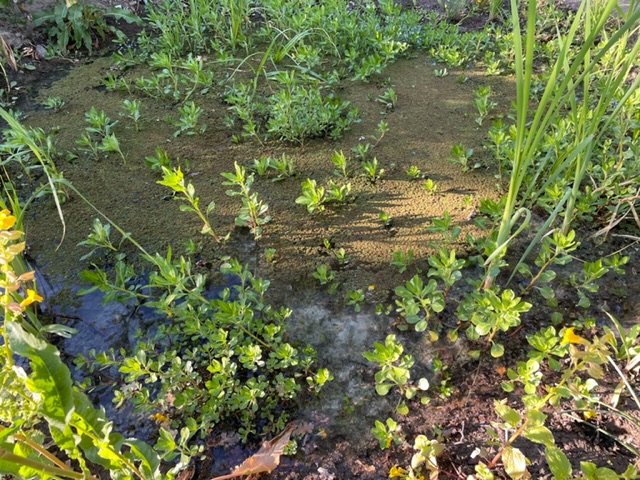
The beer and the ice cream are out looking for customers lately. People are avoiding the lake. Staggering under an overload of nitrates from agricultural fertilizers, the lake is hosting its biggest algae bloom in years. The stuff is piling up in coves, where it rots, giving off a smell of sewage.


Summer comes to fruition as pears, figs, plums, peaches and tomatoes ripen.


The pear harvest is winding down.


Clouds occurred in August, a month that was cooler than usual. The dry year is stressing the walnuts and loquats.


Then there were three guinea fowl. The fourth was run over. Its spotted feathers are still drifting along the road.

Monday, August 24, 2009

High Summer


There are still vantage points on the lake, which may be described as reassuring. These are views in which it is possible to imagine the lake in centuries past, as the Indians must have seen it, before its shoreline was largely despoiled by the Americans.

One such setting is the mouth of Rodman Slough looking south across the lake to Mount Konocti. Nearby, if the photographer edits carefully, there are other views of the essential place.


The nineteenth century American landscape painters, who tried to imbue their subject with a sense of the divine,
might still find material in Lake County. Asher B. Durand, Albert Bierstadt, and Thomas Moran, among others, painted a sublime nature in which the spirit of the young nation seemed to be embodied. A politics of identity through a sense of place developed.

But another strain in the American sensibility is one of contempt for unfettered nature. The Euro-American notion
of modifying and subduing landscapes to serve practical ends almost universally omits a sense of harmony. One highly apparent lesson of the lakeshore is the ethic in Capitalist America of "every man for himself". The result is a piecemeal
shabbiness of development which is an appalling abuse of the commons. Every man wants a slice of paradise, and in so doing destroys his own object of desire.


At the cost of creeks that run dry by early summer, we have bountiful, well-watered crops of pears, wine grapes and walnuts
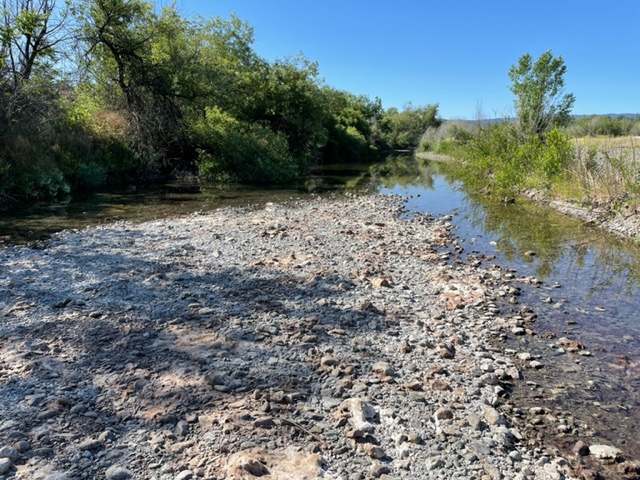
in Big Valley. Even in its water-starved state, Kelsey Creek still serves as a nice place to walk.


A pre-dawn chorus of clanging aluminum ladders issues in the auspicious day of August 11, the beginning of the pear harvest.


August is the month of flocking crows. Their numbers are down this year, perhaps the result of West Nile virus. Hundreds still wheel about, landing for a few minutes in the valley oak canopy before taking off in waves toward the lake. Each crow has its own distinct voice, presumably easily recognized by other flock members. One may be a baritone, another a tenor, one given to using its bill as a castinet, another raspy-throated.

Other conglomerations in recent days have been the ever-increasing wild turkeys, introduced to California not many years ago, and a vociferous coyote pack, which sings with as much variety and nuance as does the flock of crows. Coyote song peaks at 11 P.M. sometimes splitting into two factions at far flung points in the orchards, at other times coalescing at close quarters near the chicken coop at Shady Rock Ranch.


Acorn woodpeckers have perforated splendid totem poles.


Wednesday, June 3, 2009

The Reptiles Are Restless

A Narrow Fellow in the Grass - Emily Dickinson

It was a good day for snakes. A baby king snake, banded in black and white, nosed its way through the grass. Its temperament seemed wilder than that of the gopher snake tribe we're more used to seeing around here. Later, during the course of the day in four different locales, I saw what might have been four different gopher snakes, each about two feet long. More likely I saw the same snake four different times at various spots on the property. A black bird, sighting the serpent in the open, drove it into cover in a bed of Saint John's wort. Gopher snakes are creatures of methodical habit, patrolling their rounds near the ranch buildings.


A few days later, my attention drawn by the flaring and hopping about of a California thrasher, I saw that it was alarmed by a coiled gopher snake.This snake was a new one, bigger, and missing the last couple of inches of tail. This specimen will be readily identifiable if it shows up again. Its name will henceforth be "Stumpy".


A lone quail egg sat unmolested and under mysterious circumstances on the ground among oak saplings.


A group of 4H girls paraded their livestock down the road on their way to the scales at the pear sheds. The girls will display their fine animals in August at the county fair.


Monday, May 18, 2009

High Spring


Life in Big Valley is so abundantly beautiful right now, it seems appropriate to show pictures while limiting the commentary.
What does one do with beauty but bask in it? The flowers and birds of the place are at their peak of productivity. Color, fragrance, light and birdsong fill the days. The nights are star-spangled and frogsong-filled.


The sun and heat are not yet so harsh in May as they will shortly be. Roses and poppies, orioles and tree swallows seize the moment. The moisture in the soil has not yet been blasted by summer heat. Some of the meadow grasses are still coming up green.


Thanks to showers early in the month, the creek is still flowing and ringing at night with the chorus of Western toads and Pacific treefrogs. The valley oaks and cottonwoods are in full leaf.


The free ranging guinea fowl and ducks make their continous rounds, eating all the way.


Among the many productions of the ranch are acorns, figs, loquats, pears, tomatoes, grapes, and walnuts. Then there are the many broods of barn owls, swallows, bluebirds, quail, woodpeckers, gophers, lizards, snakes, bats, squirrels and jack rabbits. But the crops of oak galls, bird feathers, and obsidian fragments are also impressively abundant.


Wednesday, April 22, 2009

A Glass Doorknob


One day in January of this year a box arrived at the post office from Dave and Wanda Benson. The box contained a cut glass doorknob, a wayward relic of their former home, the old Benson ranch house. Gazing into the sunlit facets of the humble yet dazzling gift, it was easy to imagine a time, eighty-seven years ago, when the doorknob was part of the then newly-built bungalow, which we now inhabit. I imagined the Bensons coming upon it among their unpacked goods in Idaho with the realization that the right place for it was back on the old ranch.

My eye, gazing into the clear glass eye of the doorknob, looks inward and back in time.

The record of settlement by the Anglo-Americans, only 160 years old, is written in the orchards, roads, structures and modified creek beds. But it is the old land itself, the primordial lake, the ancient oaks, and the extinct volcano that summon thoughts of the Indians.

In the peripheral sight of the mind's eye, trace elements of the Pomo Indians are just discernable in Big Valley. The hints show up in the spawning runs of hitch, in the acorn mast of the valley oaks. The wide open eye sees disintegrating trailer homes on the rancheria. There is a casino. There are new Indian tract houses and a recreation center. Several miles north, a marker denotes the "Bloody Island" massacre not far from another casino. There are Pomo names on the landscape, Konocti for one.

Family names of Anglo-American pioneers are printed on metal road signs, cast in bronze plaques, and printed on U.S. Geologic Survey maps. Sitting on a bicycle, I looked up at the green road sign with white letters spelling Benson Road against the distant backdrop of the high undulation of chaparral-covered Benson Ridge. The name of Benson is found too in the Pioneer Cemetery among periwinkle, poison oak, and blue-eyed grass.


Kelseys are also seen in the pioneer cemetery. The creek and the very town are named for them. The big white K branded onto the face of the mountain denotes not Konocti, but Kelseyville. The obsidian-studded monument to Andy Kelsey stands above his remains, and also marks the site of his adobe house, the first house erected in the region. Among the obsidian chunks, locally called bottle rock, is one piece at top and center of the monument, fashioned into the shape of an oversized arrowhead. It's as if the arrow of retribution is still falling toward the earth where Kelsey lies. His wife, Nancy, was the first Anglo-American female to cross the North American continent into California for good or ill. The Pomo, enslaved by Kelsey to build his house, killed their master in the Fall of 1849, and were, in turn, killed with their women and children by the U.S. Cavalry at their village near the upper end of the lake.


The shoreline of Clear Lake is heavily built up in many areas, but, from a boat, it is apparent the Lake remains a vital refuge for grebes, pelicans, ducks, gulls, ospreys, cormorants, herons, eagles, turtles, otters, and fish large and small.


The flocks of white pelicans, 3,000 strong, seen last fall are down to a small fraction of that size as most have dispersed to breeding lakes in the inter-mountain West.


I got some freshly laid eggs at Shady Rock Ranch, where the poultry seem well contented with their domestic arrangements.
Brewer's blackbirds frequent the peafowl pen for grain. When frightened, they cling to the chickenwire awaiting their chance to settle down to their pilfering ways with no intention of flying away until they are sated.


This week, the valley oaks' tiny chains of green flowers are in full force.

Tuesday, April 21, 2009

Pear Blossom Time


By April 11 in the orchard, blossoms had begun giving way to leaves. Frosty nights still lay ahead, but days were warm.


Two types of hummingbird, Rufous and Anna's, along with bumble bees and honey bees, hurried among the coral-red quince blooms as if knowing the feast would be short-lived. The five-year-old tree peonies flowered for the first time.


In counterpoint to the burst of renewed life, a solitary rooster, following the tradition of old Cape Buffalo bulls and elderly Hindu men, graduated from being a householder to wandering the world as a sadhu. He rested for hours at a time on a bed of dry oak leaves among oak saplings or basked in the reflected heat coming off the corrogated metal bunkhouse. He picked at some spilled seed beneath a bird feeder in a disinterested way as if half remembering a former appetite. He was
not yet past the need to occasionally check in with his old rivals on the neighboring ranch. But he wouldn't bother anymore to
visit them. Staying put, he let loose a series of hoarse cock-a-doodle-dos, loud, but not so powerful as they had been in previous seasons. He seemed gratifed that he still elicited a faintly heard response from roosters in the distance. His increasing detatchment had a kind of dignity of foreknowledge.


Bluebirds managed to establish a nest in one of the boxes in spite of fierce competition from tree swallows, which colonized several boxes. Bluebirds construct tidy nests of straw, while tree swallows utilize poultry feathers in abundance. While bluebirds keep their nests clean, swallows soon foul theirs with guano. On the ranch, the swooping, twittering swallows are one of the most anticipated sights of Spring.


The columns of perforations left by the pair of red-bellied sapsuckers last Fall does not seem to have compromised the vigor of the young valley oak. The trunk was almost girdled by the birds, but leafout is happening, albeit later than that of most of the other oaks. But this particular tree has always been late to green up.


Rainy Aprils in past years have brought as many as thirty common mergansers to our section of the creek. This season I saw six. A pair is staying close to the woodduck box.


Since I ended the epoch of field tilling, the harrow has been languishing in meadow grasses.


Monday, March 30, 2009

Spawning of the Hitch


In this dry year the gates of the retention structure on Kelsey Creek were closed earlier than usual. The gates captured the flow from February rains as water backed up into the upstream riparian zone and helped recharge the local water table. But with the coming of the hitch migration in early March, the gates were opened allowing for the passage of thousands of the fish. It was easy to see them paired off or in gangs thrashing in the riffles. Many had passed through the gates headed upcurrent for points south. Continuous numbers were visible as they moved up from the lake and beneath the Soda Bay Road bridge. Some schools leisurely swam downstream, their spawning presumably completed.

A neighbor, remembering the heavy rains of an El Nino year in the 1980s, told me of the night when the flooded pear orchards were alive with splashing hitch under the light of a full moon. When the flood waters dropped, vast numbers were stranded, just as had been documented in old photographs a hundred years earlier.


The herring spawning runs that occur every Spring in New England are a local cultural touchstone, a promise of the coming end of harsh weather, and a tourist attraction. Called herring in some watersheds, such as on Cape Cod, "buckies" in others, particularly in Rhode Island, the species arriving in the brooks from the Atlantic is actually the alewife.

The hitch strongly resemble the menhaden or herring. Silvery, scaly and bony, they are an impressive ten-inch minnow found only in the tributaries of San Francisco Bay, Monterey Bay, and Clear Lake. Predators attend the spawning including ospreys, black-crowned night herons, great blue herons, and raccoons.


The creek as an artery of life coursing through Big Valley's monocultures of pears, grapes and walnuts, often offers surprises.
Beyond the hitch spectacle, there was a Western pond turtle, which somehow made a living in the creek, which is dry for half the year. There were also deer tracks, a rarity so far from the wooded hills surrounding the valley. Turkey feathers, too, were unexpected, until I remembered it was the first day of the Spring turkey hunt. Maybe the birds, like the deer, were seeking refuge far from where the hunters stalked. A camouflaged turkey hunter I spoke with earlier in the day at the Cache Creek wildlife area lamented the elusiveness of his quarry. I pitilessly told him about the flock of three hundred I had seen on private land.


After watching the massing hitch at the Soda Bay Road bridge I turned to look at Mount Konocti above the vinyards.


Meanwhile, back at the ranch, a peach tree bloomed.